Einstein at the Beach
A Message in a Bottle
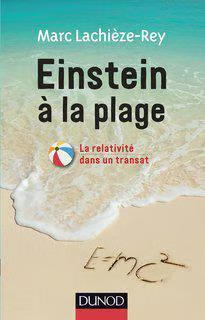
Einstein found a bottle with a message...

What if Einstein was mistaken on a crucial point in the reasoning that led him to special relativity?
If so, the conception of time conveyed by physics for more than a century would not correspond to what actually occurs. Here are, in two statements, the key steps that can lead to this conclusion:
1. Time Cannot Be Traced Back
One must not allow time to be “traced back,” even along a line of simultaneity, because it is impossible for something that has existed at a given position relative to an observer to later not yet have existed at that same position relative to that same observer.
2. The Rotation of the Line of Simultaneity
Yet in special relativity, when a body accelerates, the rotation of its line of simultaneity leads, in certain configurations, to a backward tracing of time along that line of simultaneity—something that is in fact impossible once the real existence of moving bodies is taken into account.
The Physical Meaning of Simultaneity
For the speed of light to be invariant, the principle of the relativity of simultaneity must correspond to what actually occurs. This also means that one must give physical meaning to the lines of simultaneity by making them correspond to the existence of moving bodies; and it is from this that one sees that contradictions arise.
Scientists fail to notice this because they adopt a purely operational approach, without giving full physical meaning to the lines of simultaneity. Moreover, even from a mathematical standpoint, this should be demonstrable.
The book also opens a path toward an experimental test. If there is absolute simultaneity, the speed of light can no longer be invariant in every situation—implying a coming revolution in physics. A new philosophical vision of the world, highly stimulating for research, then becomes possible.
Further Reading
Clocks, Proper Times, and the Reality of Time
The fact that clocks do not tick at the same rate depending on their position in space or their motion in no way implies that time does not exist. It simply means that the rate of physical processes depends on spatial conditions, which is very different from a denial of time itself.
One cannot arbitrarily rule out the possibility that two “identical” clocks, placed in different spatial conditions—for example, on two different floors of the same building—may run simultaneously at different rates.
Likewise, the fact that one cannot determine the simultaneity of two distant events independently of any measurement convention does not in any way imply that simultaneity does not exist. This is a limitation of our measurement procedures, not an ontological property.
Furthermore, the fact that we only measure proper durations—that is, local times associated with particular physical processes—does not imply that time as such does not exist. Here again, one confuses an operational constraint with a conclusion about the nature of reality.
Marc Lachièze-Rey overlooks these distinctions, moving from a statement about experimental limitations to a much stronger ontological interpretation, which nevertheless remains open to debate.
Philippe de Bellescize